The Beginning — Scary Videos as a Bridge
In my first post, I talked about how filming scary videos with my son unexpectedly became one of the most fun activities we had together. What started as a joke slowly turned into something much more important for me. It became one of the few things that could still genuinely pull him away from screens and into the real world.
The older he gets, the more difficult it becomes to simply say: “Let’s go for a bike ride.” “Let’s go hiking.” “Let’s just spend time outdoors.”
When he was younger, reality itself was entertaining enough. A forest was an adventure. A random abandoned structure was a mystery. A strange sound in the dark immediately became part of an imaginary world we created together.
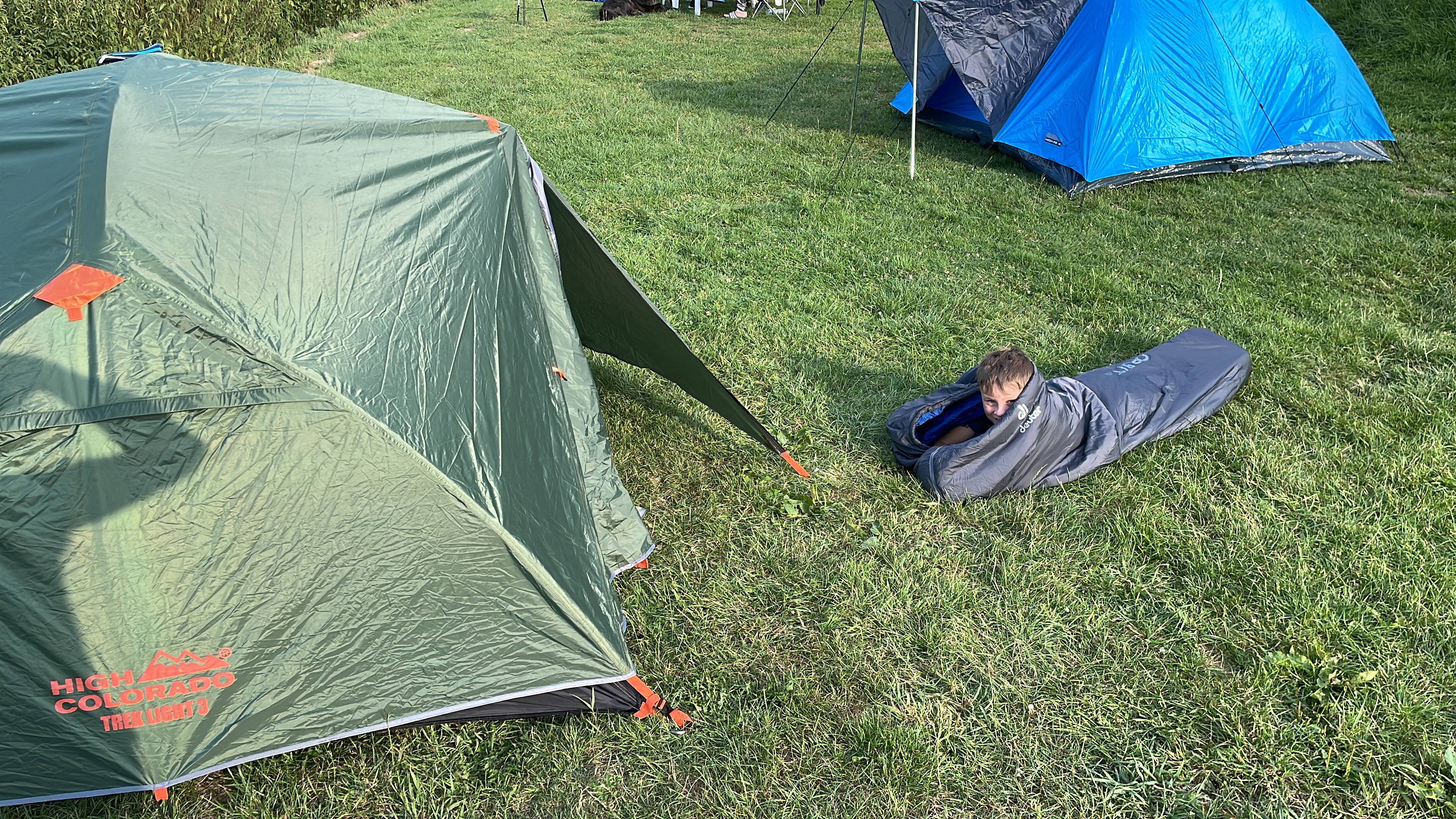
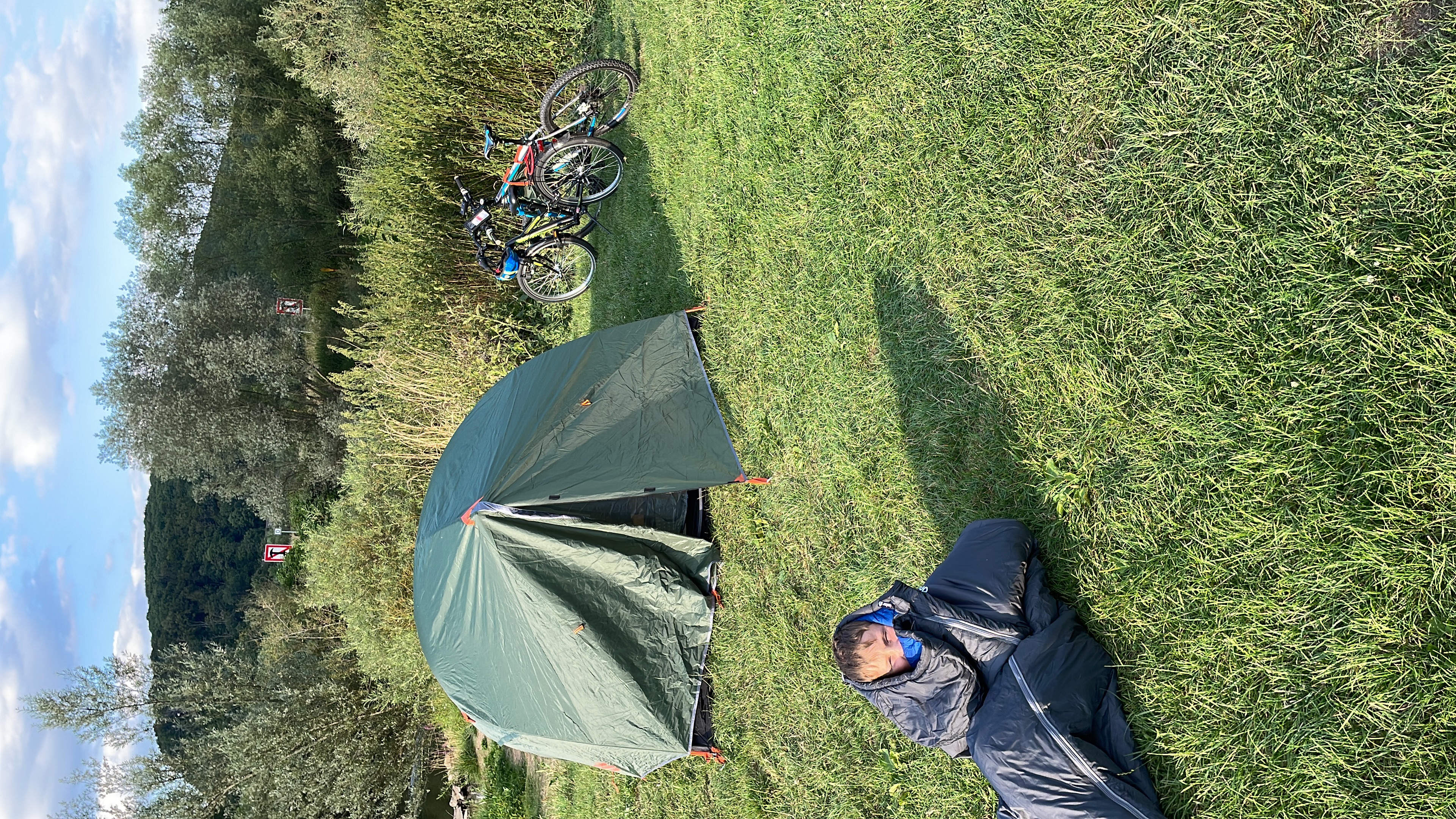
Here are some photos of us camping along the Rur river in Germany.
But modern kids grow up differently now. Their world is built around and shaped by algorithms around content, games, memes, YouTube videos, Discord conversations, Roblox servers, and endless streams of entertainment that compete for their attention every second.
What still worked surprisingly well for us was storytelling. The moment a regular walk turned into “we are filming something,” everything changed. Suddenly there was purpose. A mission. A reason to climb a rock, explore a strange path, or wait for the perfect shot before sunset.
Where we were was no longer the main activity. The story became the activity.
And that realization changed a lot for me.
”Plastic World Won”
Click to know what this title actually means.
This is the title of the song by Grazhdanskaya Oborona band that I loved when I was a teenager and I think it describes really well what happened to our world. This kind of music is not for everyone ;-). If you want to know the translation of this song, write in the comments.
My son is deeply immersed in the digital world. Most modern kids are.
He watches YouTube every chance he gets, especially whenever we loosen the screen time limits on his devices. Creators, trends, internet drama — sometimes things I barely understand myself. But that’s become the social language of his generation. Those are the topics kids talk about with classmates, cousins, online friends — basically everyone around them.
And honestly, reality struggles to compete with that. I realized at some point that he experiences the world mostly through screens.
Even global events reach him through edited videos, reaction clips, thumbnails, and algorithm-driven recommendations. More and more, his view of reality is being shaped through a screen. I’d much rather hear a 12-year-old talk about Spider-Man or Jack Sparrow than Epstein or Kim Jong Un.
And I don’t even blame him for that. This is simply the environment modern children grow up in.
What worried me more was something else: I could clearly see how the real world was slowly losing against the artificial one.
A forest cannot compete with infinite entertainment. A quiet mountain trail cannot compete with TikTok dopamine loops. A normal hike cannot compete with games designed by hundreds of psychologists and designers to maximize engagement.
And I realized I could not win this battle by simply insisting: “Nature is good for you.”
That argument is far too weak against the modern internet.
The scariest realization for me was not that my son loved computers. It was that I could already imagine the future version of him: a teenager sitting in a closed room behind a glowing monitor, emotionally disconnected from the physical world around him.
I knew I had to find another approach before that happened completely.
Don’t Fight It, Redirect It
At some point I realized something very simple.
Trying to pull kids completely away from the digital world is probably impossible now. But maybe the answer is not to fight it directly.
Maybe the answer is to redirect it.
That was the moment I started thinking: what if filming videos is not just the hook that gets him outdoors? What if it becomes something bigger?
I already knew he enjoyed the filming process itself. He liked acting in those little scary stories. He liked inventing scenarios. He liked seeing himself in the final edit.
Then another thought appeared: what if I slowly involve him in the editing too?
My son already spends enormous amounts of time around digital media anyway. Instead of treating that as purely negative, maybe I could turn it into something creative and practical.
So gradually I started showing him small things: how editing works, how music changes atmosphere, how cuts create tension, how thumbnails attract attention, how stories are built.
The plan was always there from my side, although the progress was slower than I hoped for. But over time he gradually became more involved in what we did with the videos after we came home too.
The adventure no longer ended in the forest or on the mountain trail. Back home we sat together again, processing footage, discussing ideas, adding sound effects, choosing titles, laughing at failed scenes, and trying to make the final video more entertaining.
Our hikes were transforming into collaborative creative projects.
And I noticed something important: kids become much more engaged when they are not just participating in an activity, but helping create something from it.
The “Business” Idea
Eventually I realized that filming scary videos “just for fun” might stop being enough motivation sooner or later. Kids grow up quickly. What feels magical at ten years old can suddenly feel childish at thirteen.
So I decided to act proactively.
If the creative side alone eventually loses its power, maybe responsibility and ambition could keep the bridge alive longer.
That was when the idea appeared: what if we tried turning this into something real?
Not necessarily a huge business. Not some fantasy about becoming internet celebrities overnight. But simply something tangible. Something that exists outside our home computer.
My son is currently very motivated by the idea of earning money for his own PC. I think that motivation is incredibly valuable. For the first time, the videos are no longer just entertainment to him. They become connected to effort, consistency, and long-term goals.
Suddenly views matter. Editing matters. Uploading regularly matters. Ideas matter.
Without even realizing it, he starts touching skills that schools barely spend time teaching: storytelling, media production, communication, audience attention, branding, creative thinking, working with algorithms, building something from zero.
And those skills feel incredibly relevant to the future world he will grow into.
I’ll share the concrete set of changes he did for the videos in future blog posts.
Why I Think These Skills Matter
A lot of people associate survival skills only with extreme situations. Arctic expeditions. Military scenarios. Living in forests for weeks.
But I think survival is a much broader concept than that.
Real survival often begins much earlier: remaining calm during chaos, being able to improvise, making decisions under pressure, helping others organize, staying functional when comfort disappears unexpectedly.
And modern life feels far less stable than people like to admit. The comfortable life itself is a hidden risk because it slowly makes us weaker, less resilient, and less prepared for reality. I really liked how The Comfort Crisis by Michael Easter talks about this idea — that humans were never designed for constant comfort, convenience, and passive consumption.
Natural disasters are becoming more frequent. Infrastructure failures happen regularly. Entire regions suddenly lose electricity, water, communications, or transportation. Wars that once seemed geographically distant now unfold close enough that millions of ordinary people suddenly find themselves fleeing homes they thought they would live in forever.
The uncomfortable truth is that comfort is much more fragile than modern society wants us to believe.
Most people prefer not to think about that. Especially families with children. It is psychologically easier to assume that modern systems will always continue functioning normally.
But history shows the opposite repeatedly.
That does not mean living in fear. Quite the opposite. I think practical preparedness actually reduces fear because it replaces helplessness with competence.
And honestly, many “survival skills” are simply life skills: staying calm, thinking clearly, taking responsibility, adapting quickly, working together, not panicking.
Those skills transfer surprisingly well from wilderness scenarios into ordinary life.
Schools Were Built for a Different World
Schools are heavily focused on predictable environments, memorization, standardization, and predefined career paths. But the future my son will likely face feels much more unstable, competitive, and self-directed.
The ability to create something from nothing suddenly matters a lot.
The ability to communicate online matters. The ability to present ideas matters. The ability to build an audience matters. The ability to learn independently matters. The ability to adapt quickly matters.
And strangely enough, our strange little father-and-son survival videos touch many of those areas naturally.
At the same time, outdoor experiences teach things no classroom really can: discomfort tolerance, uncertainty, navigation, risk assessment, patience, physical resilience, situational awareness.
I do not think schools are useless. Far from it. But I do think many important modern skills are learned outside them.
What I Actually Want
At the end of the day, I do not really care whether this becomes a successful business or not.
Of course it would be amazing if one day my son could proudly say he bought his own PC with money earned from projects we built together. That would be a fantastic experience for him.
But that is not the main goal.
What I really want is much simpler.
I want him to stay connected to the real world. I want him to feel comfortable outside artificial environments. I want him to know how to handle uncertainty without panic. I want him to have curiosity instead of passivity. I want him to know how to create things instead of only consuming them.
And selfishly, I also simply want us to continue having adventures together for as long as possible.
Because one day he will grow older, build his own life, and maybe stop going on those strange little missions with me entirely.
But perhaps years later he will still remember those moments: walking through the mountains, inventing ridiculous survival stories, climbing rocks for “important missions,” filming scenes nobody asked for, laughing at terrible edits late at night, trying to build something together out of almost nothing.
And honestly, if all of this gives us a few more years of genuine connection before adulthood fully takes over, I’d consider the mission accomplished.